Comprehensive Introduction to Sintered Copper Clutch Friction Disc
I. Basic Definition and Core Composition
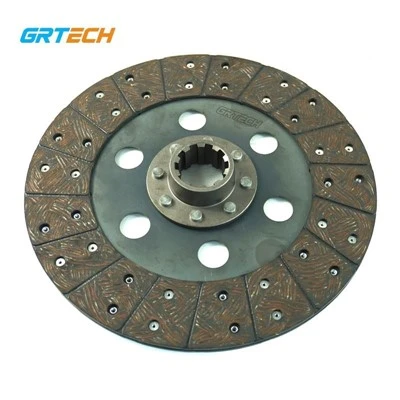
A Sintered Copper Clutch Friction Disc is a high-performance friction component manufactured by powder metallurgy technology. It takes electrolytic copper powder as the main matrix (generally accounting for over 60%), and is produced through processes including powder mixing, cold pressing, and high-temperature sintering with the addition of various alloying elements and functional fillers.
It adopts a typical composite structure: steel backing + transition layer + sintered copper friction layer. The steel backing provides rigid support, while the friction layer undertakes torque transmission and friction bearing.
II. Material Formula and Manufacturing Process
1. Core Material Composition (Typical Formula)
| Component Type | Main Ingredients | Content Range | Core Function |
|---|---|---|---|
| Matrix Material | Electrolytic Copper Powder | 60-80% | Deliver high thermal conductivity, excellent electrical conductivity and toughness |
| Alloy Strengthening Phase | Tin, Zinc, Nickel, Molybdenum | 5-15% | Improve strength, hardness and wear resistance |
| Friction Modifier | Graphite, Molybdenum Disulfide | 5-10% | Stabilize friction coefficient, reduce wear and noise |
| Reinforcing Phase | SiC, Al₂O₃, Ceramic Particles | 3-8% | Enhance high-temperature stability and impact resistance |
| Auxiliary Ingredients | Iron Powder, Sulfides | 2-5% | Optimize density and friction performance |
Modern high-end products generally adopt asbestos-free and lead-free eco-friendly formulas, complying with international environmental standards such as RoHS.
2. Key Manufacturing Processes
Batching and Powder Mixing: Proportion each component precisely and mix evenly in a dedicated mixer for 4 to 8 hours.
Cold Press Forming: Compress the mixed powder into preforms under a pressure of 100-300 MPa.
High-Temperature Sintering: Sinter under vacuum or protective atmosphere at 900-980°C (special temperature for copper base) to realize metallurgical bonding of powder particles.
Shaping and Machining: Perform precision cutting and grinding to ensure dimensional accuracy (tolerance ±0.02mm) and surface flatness.
Surface Treatment: Optional anti-corrosion treatments such as galvanizing and passivation to extend service life.

III. Core Performance Parameters (vs. Iron-Based Sintered Friction Disc)
| Performance Index | Sintered Copper Friction Disc | Iron-Based Sintered Friction Disc | Remarks |
|---|---|---|---|
| Friction Coefficient (μ) | Dry: 0.25-0.40; Wet: 0.08-0.35 | Dry: 0.35-0.50; Wet: 0.10-0.40 | Copper base features higher stability with smaller fluctuation |
| Maximum Operating Temperature | Instant: 600°C; Continuous: 400°C | Instant: 800-1200°C; Continuous: 600°C | Iron base has better thermal stability |
| Thermal Conductivity | 80-120 W/m·K | 40-60 W/m·K | Thermal conductivity of copper base is over twice that of iron base |
| Counterpart Wear | Low (low adhesion and seizing tendency) | Relatively high (easy affinity with steel/cast iron) | Copper base protects flywheel and pressure plate |
| Density | 6.0-6.8 g/cm³ | 6.5-7.2 g/cm³ | Copper base is slightly lighter with lower moment of inertia |
| Torque Capacity | Medium (200-800 Nm) | High (400-1500+ Nm) | Iron base suitable for high-horsepower applications |
| Wear Resistance | Excellent in wet conditions, good in dry conditions | Excellent in dry conditions, average in wet conditions | Copper base more applicable to wet clutches |