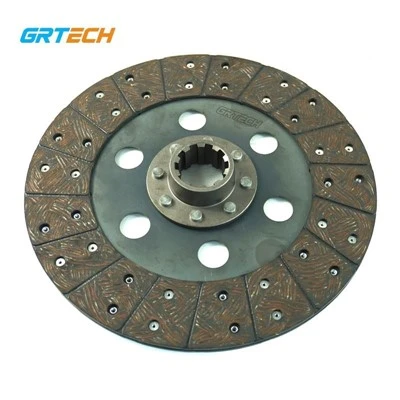
Process parameters of friction materials (一)
Pressed plastics made by dry production process and wet production process usually have two methods when they enter the following hot pressing molding process. The hot stamping mold has the same (slightly smaller) blank, and then puts the blank in the hot stamping mold for compression molding; the other is to directly add the pressed plastic to the hot stamping mold for compression molding. Regardless of the process method, the pressed plastic is required to have certain process properties so that it can meet the process requirements of the pressed plastic in the thermocompression forming process. Normal operation, production efficiency, and especially product quality will have a direct impact.
The process performance of compression plastic mainly includes: curing speed, volatile content, fluidity, fineness and uniformity, bulk density, compression rate, compaction and so on.
1. Curing speed
Curing speed, also known as hardening speed, refers to the speed at which thermosetting resins or plastics (including thermoplastic phenolic resins and thermosetting phenolic resins and their pressed plastics) transform into insoluble and insoluble states at a certain temperature, usually expressed in seconds required . The curing speed of the pressed plastic should be controlled within a certain range. If the curing speed is too slow, the curing time will be long, and the pressing cycle of the pressed plastic in the hot pressing mold will be long, and the production efficiency will be low, which will affect the output of the hot pressing process; if the curing speed is too fast, the pressed plastic may not be evenly distributed in the pressing mold. It fills the entire mold cavity, and before it is fully formed, it cannot flow due to solidification, resulting in damage to the pressed product and becoming a waste product. The curing speed of the compression plastic mainly depends on the curing speed of the phenolic resin in the compression plastic component. Therefore, the curing speed of the pressed plastic is related to the following factors:
(1) The degree of polycondensation of the resin: the degree of polycondensation of the resin is deep and the curing speed is fast. On the contrary, the degree of polycondensation of the resin is low, and the curing speed is slow.
(2) The amount of curing agent (stabiliser): For thermoplastic phenolic resin, the amount of curing agent hexamethylenetetramine increases, and the curing speed increases; otherwise, the curing speed slows down.
2. Liquidity
The fluidity of the plastic means its ability to fill the mold cavity under certain temperature and pressure conditions. Compressed plastics with normal fluidity can fill the mold cavity well through flow distribution under specified pressing conditions (temperature, pressure), and obtain satisfactory molded products. Compressed plastics with too little fluidity cannot fill the entire cavity under the specified pressing conditions. As a result, the compressed tablet products have defects such as trachoma, missing edges, missing corners, white surface, loose structure, and poor strength, so that the product cannot meet the quality requirements and become inferior and waste products. For thin-walled or large products with complex shapes, even the required shape cannot be obtained. Or the density of the part of the product is inconsistent, the mechanical strength is uneven, and the quality is reduced.
Under the specified pressing conditions, that is, under certain temperature and unit pressure conditions, the fluidity of the pressed plastic depends on the following factors:
(1) Resin fluidity, fluidity is an important indicator of resin products.
(2) The ratio of the amount of adhesive (including resin and rubber), the increase in the amount of adhesive in the pressed plastic will help to improve the fluidity of the pressed plastic.
(3) Volatile matter content, when the volatile matter content is lower than 3%, the fluidity of wet-process short-fiber pressed plastics becomes poor.