Copper-Based Powder Metallurgy Brake Pads for High-Speed EMUs
I. Structural Composition (Double-layer / Multi-layer)
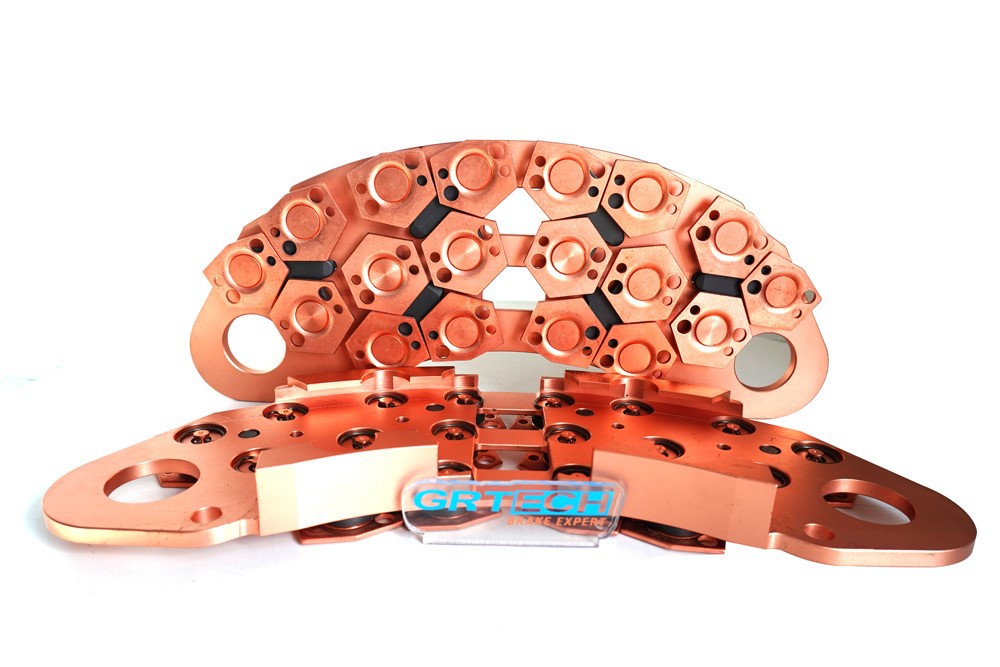
Friction Layer (Copper-based Composite Material)Taking copper (Cu) as the matrix (50%–70%), blended with iron (Fe), tin (Sn), graphite (lubricant, 7%–16%), silicon dioxide / silicon carbide (friction components, 8%–15%) and other ingredients. Fabricated via vacuum hot-press sintering of powder metallurgy.
Steel Back PlateMade of high-strength alloy steel (e.g., 30CrMnSiA). It provides mechanical strength, mounting rigidity and basic thermal conductivity, and is integrally sintered with the friction layer.
Definition of "Copper-backed"In industry parlance, the assembly of copper-based friction layer plus steel back plate is generally referred to as copper-backed brake pads. Its core feature is the copper-based friction layer, which differentiates it from iron-based, semi-metallic and organic brake pads.
II. Core Performance (Adapted for High-Speed Braking)
High Thermal Conductivity (Core Advantage)The thermal conductivity of copper matrix is approximately 401 W/(m·K). It can rapidly dissipate heat of 300–500 ℃ generated during braking at 350–380 km/h, avoiding thermal cracking, thermal fade and brake disc overheating.
Stable Friction CoefficientAt high temperatures (300–500 ℃), the friction coefficient remains stable at 0.34–0.41. It far outperforms organic materials (prone to softening) and iron-based materials (prone to adhesion), enabling controllable braking distance.
Wear Resistance & Long Service LifeWear rate ≤ 2.9 mg/(N·m). Suitable for frequent start-stop operation and long downgrade braking, with a service life up to 100,000–150,000 kilometers.
High Strength & Thermal Shock ResistanceHigh sintering bonding strength, capable of withstanding shear force of 12–15 MPa. It features vibration resistance and thermal shock resistance, with low risk of block falling and cracking.
III. Differences from Conventional Steel-Backed Brake Pads
Copper-backed (Copper-based)The friction layer is made of copper-based powder metallurgy, with ultra-high thermal conductivity, excellent high-temperature stability and superior wear resistance. Used for high-speed EMUs operating at 350 km/h and above, with a relatively high price.
Steel-backed (Iron-based / Semi-metallic)The friction layer adopts iron-based or semi-metallic materials, with ordinary thermal conductivity and obvious high-temperature performance fade. Applied to EMUs of 200–250 km/h and ordinary-speed trains, with low cost.
IV. Key Manufacturing Process Points
Batching and Powder Mixing: Uniform ball milling of copper powder, alloy elements, lubricants and friction additives.
Cold Press Forming: Compressed into green bodies of the friction layer.
Vacuum Hot-Press Sintering: Sintered integrally with the steel back plate at 750–850 ℃ under high pressure to ensure bonding strength and compactness.
Finish Machining: Grinding the friction surface and drilling mounting holes to guarantee dimensional accuracy and flatness.
V. Application & Environmental Protection Trend
Mainstream Application: Copper-based brake pads are standard equipped for 350 km/h and above models such as Fuxing CR400 and CRH380 series.
Environmental Restrictions: The EU has imposed a requirement since 2025 that the copper content in brake pads shall be less than 0.5%. Domestic non-copper ceramic-based brake pads have been developed as alternatives and are being gradually promoted.
VI. Common Failure Modes
Thermal Fade: Ultra-high-speed operation (380 km/h+) or continuous braking causes softening of the friction layer and decline of friction coefficient.
Partial Wear / Block Falling: Uneven installation, thermal deformation or foreign matter intrusion leads to excessive local wear or shedding of friction blocks.
Steel Back Plate Corrosion: Rusting of the steel back plate in humid environments, impairing bonding strength and mounting accuracy.