Copper-based brake pads
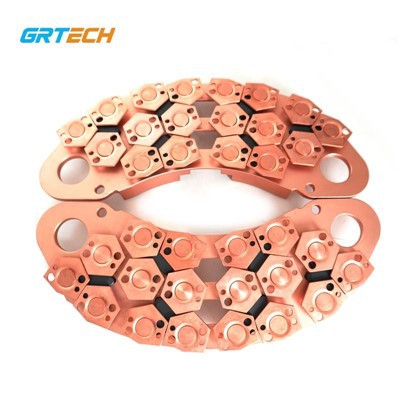
Copper-based brake pads are high-performance friction materials made with copper as the main matrix, supplemented by various metal and non-metal components. They are widely used in fields requiring high braking performance, such as high-speed trains, wind turbines, motorcycles, and electric vehicles. The following are their core characteristics and application details:
1. Material Composition and Working Principle
Material Formulation
Copper-based brake pads usually take copper powder (54-67wt%) as the matrix, with added reinforcing metals like iron, tin, and nickel, as well as graphite and MoS₂ as lubricating components, and mullite, SiC, zircon sand, etc., as friction components. For example, the formulation for high-speed trains will include iron-chromium alloy (8-14wt%) to improve high-temperature strength, while electric vehicle brake pads may have a reduced metal content to lower costs.
Friction Mechanism
During braking, the material achieves braking through abrasive wear (hard particles cutting the surface), adhesive wear (local fusion and peeling of the material at high temperatures), fatigue wear (micro-crack propagation caused by cyclic stress), and oxidative wear (formation and shedding of oxide films at high temperatures). At high temperatures, copper's high thermal conductivity (about 400 W/m・K) enables rapid heat dissipation, reducing thermal fading. In addition, a third body layer composed of wear debris and oxides will form on the friction surface, further regulating the friction performance.