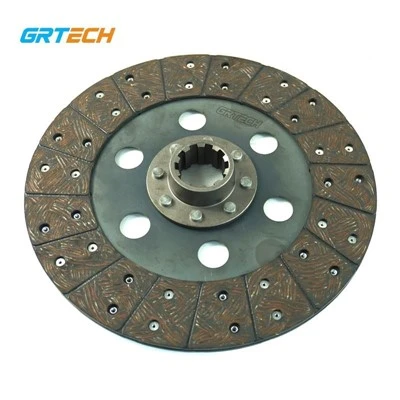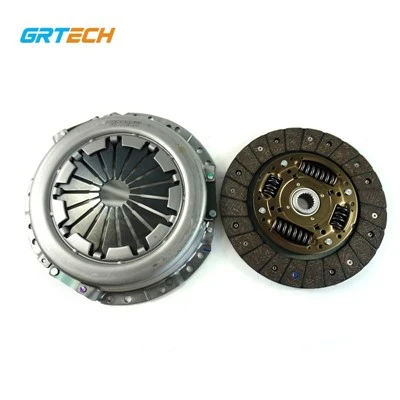
GRTECH Group has delivered 60,000 pieces of clutch diaphragm springs to OEM clutch manufacturers, a shipment that underscores the group's position as a volume supplier of core elastic components rather than merely an aftermarket parts vendor.
The diaphragm spring is the load-deflection heart of a diaphragm-spring clutch cover: its geometry and material condition determine clamping force stability, release feel, and the fatigue margin available across the clutch's service window.

Material foundation and specification envelope. GRTECH manufactures diaphragm springs from 50CrV4 and 51CrV4 spring steel, with an outside diameter range of 160–430 mm, thickness from 1.8 to 5.8 mm, and load capacity spanning 3,000–36,000 N.
Production is executed against the Chinese automotive industry standards QC/T25-2004 and QC/T27-2004, giving OEM clutch manufacturers a documented dimensional and performance baseline rather than a drawing-only handshake. The specification envelope covers passenger car, light truck, bus, and heavy-duty truck applications, allowing an OEM to source multiple diaphragm spring variants from a single qualified process stream.

Load–deflection behaviour as a design asset. The diaphragm spring's defining engineering property is its nonlinear elastic characteristic: within the permissible wear range of the friction facing, clamping force remains substantially unchanged-or may even rise slightly-so torque capacity does not decay as the disc wears.
This is not a passive virtue. It is the property that lets an OEM clutch engineer hold release bearing load build-up within a narrow band and preserve pedal feel across the wear cycle. At high rotational speed, the diaphragm spring also loses less clamping force than a comparable coil-spring arrangement, contributing to performance stability in engines that see sustained rpm.

From material to fatigue margin: the process chain. A diaphragm spring that meets a load specification on the bench is not automatically a diaphragm spring that survives a million release events. GRTECH's process sequence addresses the gap between static compliance and fatigue durability. Quenching and tempering establish a tempered sorbitic microstructure with the toughness needed to resist crack initiation.

A controlled flattening-and-holding treatment-pressing the spring flat and retaining it under load-introduces beneficial residual stresses in the high-stress zones so that operating stresses are partially offset before the part ever sees a clutch cycle. Shot peening of the concave surface further raises fatigue strength by inducing compressive residual stress at the surface layer. The release fingers receive localised hardening treatment to resist wear at the contact point where the release bearing applies force.

Validation against the OEM durability bar. Under QC/T bench practice, a diaphragm-spring cover assembly subjected to 1.0 × 10⁵ general release cycles or 5.0 × 10⁵ intensified release cycles must still meet defined retention criteria: maximum release force variation no greater than 10% of initial value, pressure plate clamping force no less than 90% of initial, pressure plate lift no less than 90% of initial, and no cracks or fractures in any component.
Release finger wear at the contact end is capped at 30% of original thickness. These are not abstract targets; they define what an OEM clutch manufacturer is buying when it specifies a diaphragm spring for a platform that will carry warranty exposure.
#grtech #clutchdiaphragmspring #diaphragmspring #clutchassembly