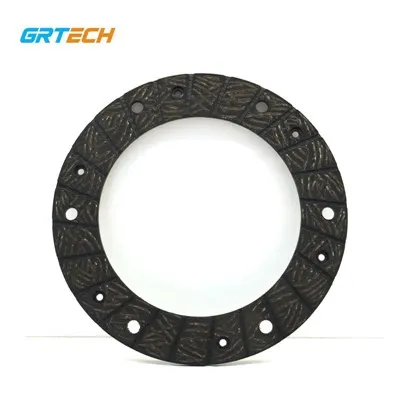
What are the types of racing car clutches?
Racing car clutches: Some racing car clutches adopt advanced technologies such as electronic control or pneumatic control. For example, most Formula One racing cars use electro-hydraulic control clutch systems. The electronic control unit precisely controls the engagement and disengagement of the clutch according to various parameters of the vehicle, such as speed and engine speed. The reaction speed is extremely fast, and the control accuracy is high. Some racing cars also use sequential shifting systems with special clutch control logics, which can achieve fast and efficient shifting operations.
Ordinary car clutches: Usually, the driver controls the working state of the clutch by stepping on the clutch pedal through mechanical or hydraulic transmission mechanisms. This control method relies on the driver's operating experience and skills, and the reaction speed and control accuracy are relatively low.
Engagement and disengagement characteristics
Racing car clutches: To meet the rapid shifting requirements of racing cars during high-speed driving and intense driving, their engagement speed is usually faster. They can efficiently transmit the engine power to the transmission in a short time, reducing the power interruption time and improving the acceleration performance of the racing car. At the same time, to adapt to the working conditions of high speed and high torque, the disengagement of racing car clutches is more thorough, ensuring that the connection between the engine and the transmission can be completely disconnected when shifting or when the power needs to be cut off, avoiding the phenomenon of power dragging.
Ordinary car clutches: They pay more attention to the smoothness and comfort of engagement to ensure that the vehicle can start and shift gears smoothly during daily driving, reducing the discomfort of passengers. Their engagement speed is relatively slow, and the degree of disengagement does not need to be as extreme as that of racing car clutches. In some cases, even if the clutch is not completely disengaged, it will not have a great impact on the normal operation of the vehicle.
Application of the semi-engagement state
Racing car clutches: For some racing cars, such as those with special clutch structures (such as serrated friction plates and springless devices), there is no semi-engagement state, or the use of the semi-engagement state is very limited. Because in order to ensure that the engine does not slip during high-speed shifting, the clutch structure of these racing cars is specially designed to have only two states: full engagement and disengagement.
Ordinary car clutches: The semi-engagement state is a commonly used working state of ordinary car clutches during daily driving. For example, during vehicle starting, climbing, and low-speed following, the driver controls the stroke of the clutch pedal to make the clutch in the semi-engagement state, achieving a flexible connection between the engine and the driving wheels, so as to better control the vehicle speed and power output and prevent the engine from stalling or the vehicle from surging.