

Main research directions of friction materials
In order to adapt to the development of the machine industry, refinement and exploration of new friction materials, focusing on the following aspects: to improve the wear resistance of the material, which determines the service life of the braking device; to obtain a sufficiently high and stable coefficient of friction to ensure the reliability and smoothness of the work of the braking and transmission devices.
The heat resistance of friction materials is basically characterised by two indicators: the resistance to oxidation at high temperatures and the ability of the metal matrix on which the material is based to maintain sufficient mechanical strength. In order to achieve higher operating temperatures, there has been a transition to more refractory metals and more complex alloying. Such as in the heavy load under more iron based materials instead of bronze based materials: in order to improve the working temperature and mechanical strength limit of copper based materials, aluminium instead of tin to make copper alloying; iron based materials in the addition of nickel, cobalt, chromium, manganese, tungsten, molybdenum and other elements to make the iron alloying, in order to further improve the iron based friction material thermal stability and mechanical strength.
Iron-based friction materials in contact with iron at high temperatures. The unstable graphite is also increasingly tending to be replaced by inert anti-seize agents (such as boron nitride). Under heavy loads, nickel- and tungsten-based powder metallurgical friction materials are proposed. To improve their oxidation resistance, friction materials based on stainless steel fibres are proposed. For wear resistance, the same multi-alloying is used to increase the strength of the metal matrix of the friction material.
In order to improve and stabilise the coefficient of friction, a lot of research work has been carried out in exploring new friction agents and anti-seize agents. In order to improve the coefficient of friction of iron-based friction materials added such compounds: such as boron carbide, silicon carbide, zirconium carbide, boron nitride, etc.. For heavy load work, as the friction agent of silicon dioxide with carbide and nitride to replace.
In copper-based materials, silica, asbestos, mullite and aluminium oxide are used effectively as friction agents to improve the coefficient of friction. Molybdenum disulphide, tungsten disulphide and boron nitride are widely used in iron-based materials to adjust the coefficient of friction and improve anti-scuffing properties. The fusible metal lead, tin, bismuth, antimony, cadmium and other additives pay more attention to, they are in the friction due to the increase in temperature and turn into liquid, to prevent the production of stick-slip phenomenon, to stabilise the coefficient of friction is advantageous. In the friction material to add than pure carbide or pure nitride more stable, higher strength of the complex compound has done a lot of work. Iron-based and copper-based materials in a solid solution type of titanium or zirconium oxygen, carbon, nitrogen compounds TiO-TiN-TiC or Zr-ZrO-ZrN, the coefficient of friction of this material is 0.55, wear resistance can be increased by more than 9 times.
At a friction speed of 40 ml/s, friction materials with greater than 2% titanium oxide and 3% to 10% oxides of silicon, aluminium, zirconium, magnesium, beryllium, calcium and chromium in iron-based and copper-based materials are recommended.
One of the new directions proposed is to have the pores of the pre-sintered metal matrix incorporate finely ground glass powder, which is done by impregnating it with a silicone resin containing suspended particles of glass, followed by a supplementary heat treatment.
If in the past the manufacture of powder metallurgical friction materials was mainly based on practical experience, in the future the main attention will be paid to the study of the mechanism of friction and wear during the operation of the friction pair, which will provide a scientific basis for the design of friction materials with the required properties.
Main research directions of friction materials
Popular Products

GRTECH 231010910 High Quality Clutch Cover for John Deere
231010910 12inches Tractor Clutch Cover Clutch Pressure Plate for John-Deere

GRTECH M104100-2 Excellent Clutch Kit For Mack
M104100-2 Clutch Parts Truck Clutch Kit for America Series Heavy Duty Truck

GRTECH 107683-4CB Good Performance Clutch Kit For MACK
Heavy Duty 14 Clutch assembly for 1-3/4 input shaft. 8 springs and 4 paddles for up to 680 Lb/Ft torque.

Grtech Excellent Racing Clutch Kits With Push/pull Designs, Twin/triple/multi...
Grtech Racing Clutch Kits conquer all motorsport challenges. Our range features push/pull designs,
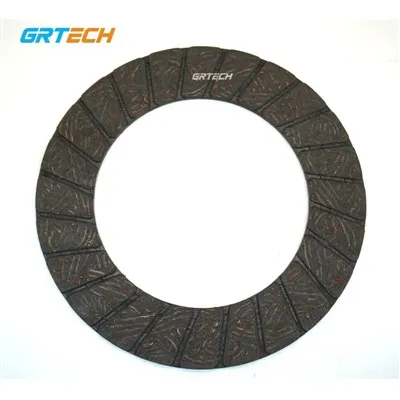
GRTECH GRT-0419A Factory Supply Clutch Facing For All Models
Grtech GRT-0419A clutch facing features steady friction performance with a small dynamic-static difference. It delivers
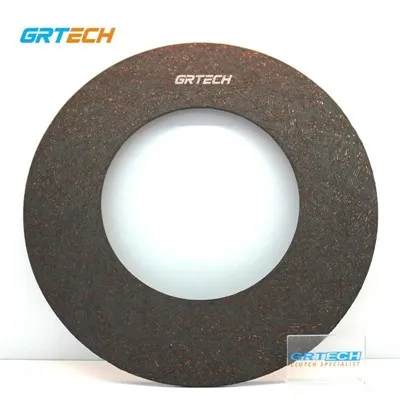
GRTECH GRT-510D High-performance Clutch Facing For All Models
Engineered by Grtech, GRT-510D clutch facing features advanced friction technology with copper-enhanced thermal