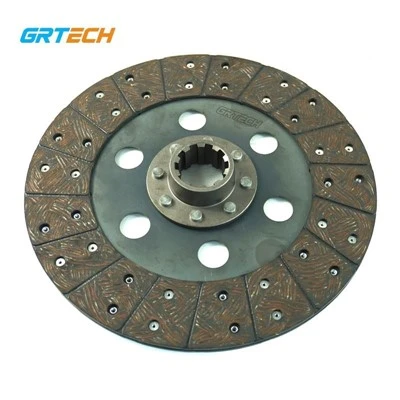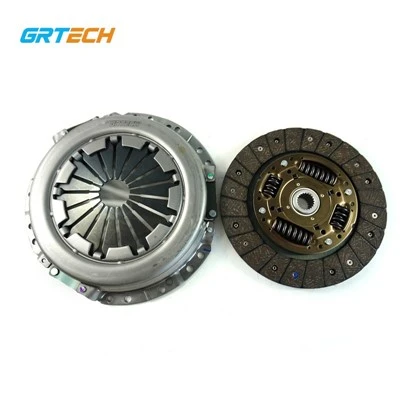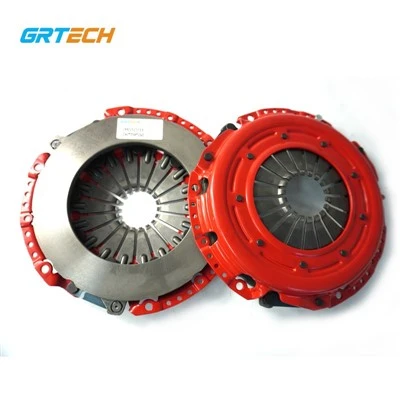
Let’s briefly talk about the clutch structure of the forklift friction plate.
The engine flywheel is the active part of the clutch. The driven plate and driven hub with forklift friction plate are connected to the driven shaft (that is, the driving shaft of the transmission) by sliding splines. The compression spring compresses the driven disc against the flywheel end face. The engine torque is transmitted to the driven plate by the friction between the contact surface of the flywheel and the driven plate, and then transmitted to the driving wheel through the driven shaft and a series of components in the transmission system. The greater the compression force of the compression spring, the greater the torque that the clutch can transmit.
Since the car needs to maintain power transmission at all times during driving, and interrupting the transmission is only a temporary need, the active part and the driven part of the car clutch are always in an engaged state. The friction pair uses a spring compression device to meet this requirement. When you want the clutch to be disengaged, just step on the pedal in the clutch operating mechanism, and the shift fork set in the annular groove of the driven disk hub will push the driven disk to overcome the pressure of the compression spring and move in the direction of release, and interact with the flywheel. separation, the friction disappears, thus interrupting the transmission of power.
When power transmission needs to be restored, in order to make the changes in car speed and engine speed relatively smooth, the speed of clutch pedal recovery should be appropriately controlled so that the driven plate, under the pressure of the compression spring, moves in the direction of engagement and regains contact with the flywheel. The pressure between the two contact surfaces gradually increases, and the corresponding friction torque also gradually increases. When the flywheel and driven plate are not tightly engaged and the friction torque between them is relatively small, they can rotate out of synchronization, that is, the clutch is in a slipping state.
The greater torque that the forklift friction plate clutch can transmit depends on the greater static friction torque between the friction surfaces, which in turn is determined by the greater pressing force between the friction surfaces and the size and properties of the friction surfaces. Therefore, for a clutch with a certain structure, the static friction torque is a fixed value. Once the input torque reaches this value, the clutch will slip, thus limiting the torque of the transmission system and preventing overloading.