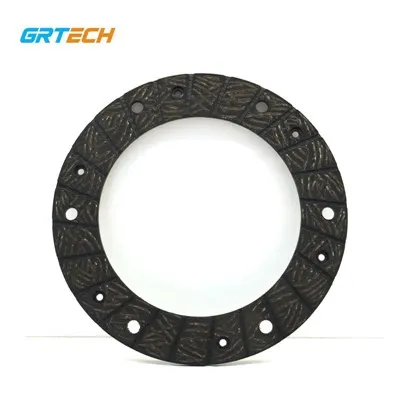
Introduction of powder metallurgy friction materials (below)
The development of modern machinery towards high speed and high load requires more and more comprehensive performance of friction materials, so powder metallurgy friction materials are becoming more and more important.
Material composition is mainly composed of base metal, lubrication element and friction element. Its structure is characterised by: a variety of particles with special properties are uniformly distributed in the continuous metal matrix, the latter play a role in thermal conductivity and bear mechanical stress, the former to ensure the friction performance. The materials used for each component are roughly as follows:
Base metal Copper-based materials are usually tin, lead, zinc alloys, good thermal conductivity, corrosion resistance, good friction resistance, mainly used in "wet" clutches. Iron-based materials have a higher coefficient of friction and heat resistance, and are mostly used in dry, heavy-duty brakes.
Lubrication components Usually graphite and lead are used, sometimes molybdenum sulphide, copper sulphide, barium sulphide or boron nitride and other solid lubricants are also used. Low melting point of lead, tin, etc. will melt partially at high temperature, which can absorb friction heat and form a film on the friction surface to prevent bonding, seizing and abrasion.
Friction components Used to increase the coefficient of friction of a material, i.e. to increase the resistance to sliding. The main ones are oxides (SiO2, Al2O3, Cr2O3), carbides (SiC, B4C) and minerals (asbestos, mullite, etc.).
Manufacturing process In order to be able to withstand or transfer great pressure or kinetic energy, friction materials are mostly sintered on steel plates. The manufacturing processes are mainly powder preparation, dosing, mixing, pressing (see powder metallurgy forming) and sintering. There are usually two forms of pressing: one is the first will be mixed uniform powder pressing forming, and then pressurised sintering on the steel plate; one will be mixed uniform powder directly pressed on the steel plate for pressurised sintering.
Sintering on the one hand is to increase the bonding strength between the particles within the powder layer, on the other hand, with the help of high temperature and pressure, so that the powder layer and the steel plate firmly together. Sintering is generally carried out in a neutral or reducing atmosphere in a "bell-type" sintering furnace where the sample can be pressurised. Friction discs are also manufactured by spraying and powder rolling. Each method has its own strengths and weaknesses, and it is important to select the appropriate material and process according to the requirements of the application.