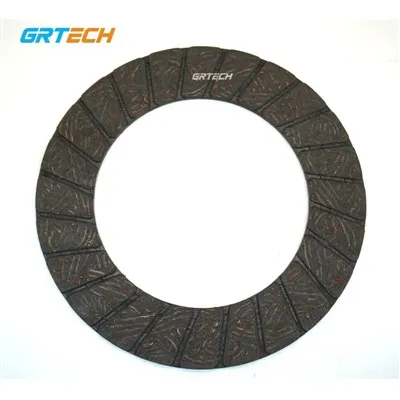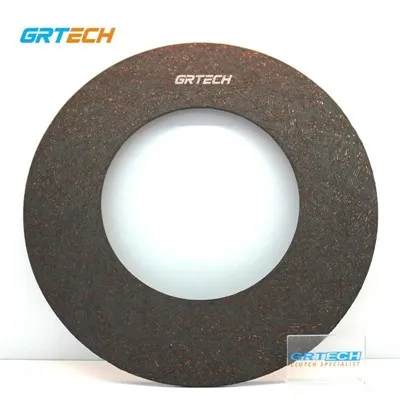
Advantages of Braided Resin Brake Bands
The advantages and disadvantages of braided resin brake bands are closely related to their material properties, structural design, and application scenarios. The specific advantages are as follows:
1. Excellent Environmental Friendliness
They do not contain harmful substances such as asbestos, complying with environmental standards like the EU's REACH and China's GB. They are friendly to operators and the environment, and are particularly suitable for fields with strict environmental requirements, such as ships and food processing machinery.
2. Long Service Life
The composite structure of the fiber braided skeleton and resin has strong wear resistance, with a wear rate usually ≤ 0.76×10⁻⁷ cm³/N・m. Its service life is 2-3 times that of ordinary asbestos or semi-metallic brake bands, which can reduce downtime losses caused by frequent replacements.
3. Stable Braking Performance
The friction coefficient (0.32-0.65) fluctuates slightly in the range of 100-200℃, and it is not prone to "thermal fading" (a sudden drop in friction coefficient at high temperatures). The braking process is stable, with sensitive response and low braking noise, making it suitable for equipment that requires frequent starting and stopping (such as elevators and winches).
4. Strong Adaptability
Different thicknesses (5-30mm), widths (≤500mm), and shapes can be customized by adjusting the braiding process and resin formula. It can be adapted to various complex braking components such as ship windlasses, mine winches, and construction machinery winches, with high installation flexibility.
5. Balanced Mechanical Properties
The braided structure endows it with high tensile strength (2-3 times that of conventional materials) and flexibility. It can not only withstand static pressure loads of more than 4.0MPa but also fit arc-shaped brake discs to avoid rigid fracture.